In this episode of The Better Leadership Team Show, I dive into the first two steps of my Talent Density System, a framework from my upcoming book The Strength of Talent. I explore how leaders can set clear expectations and assess performance to grow their people—and ultimately grow their profit.
Overview of the Talent Density System
- The Talent Density System is my signature five-step framework for growing people and profits.
- Five steps:
- Set clear expectations
- Assess performance
- Take massive action
- Drive accountability
- Cascade the process throughout the organization
- In this episode, I cover steps 1 and 2.
Step 1: Setting Clear Expectations
- Performance = Productivity + Culture Fit.
- Unclear expectations lead to unacceptable results.
- Productivity:
- Defined by 2–4 measures of success (KPIs).
- Must have targets (not just “leads” but “10 leads per week”).
- High-frequency measures (weekly > monthly > quarterly > annual).
- Both leading indicators (activities) and lagging indicators (results) are needed.
- Expectations should be set collaboratively, not dictated.
- Culture Fit:
- Defined by 3–6 non-negotiable, behavior-based core values.
- It’s about actual behaviors, not just words on a website.
- Ask: does this person make others around them better or worse?
- Leaders should set clear expectations around both productivity and culture fit.
Step 2: Assessing Performance
- Uses a two-axis model: Productivity (x-axis) and Culture Fit (y-axis).
- Four categories of performance:
- High Performing (strong in both)
- Low Culture Fit (toxic, even if highly productive)
- Low Producing (low productivity, acceptable culture fit)
- Medium Performing (in between, not high or low enough)
- Why categorize?
- Provides a common language across the leadership team.
- Leads to fact-based assessments and prescribed actions.
- Supports accountability and allows measurement of a “Talent Density Index.”
- I used to call them A, B, C, and Toxic C players but shifted to more dynamic terms like performing vs. player to avoid static labeling.
- Example: A “B player” might be performing that way because of poor leadership, not innate capability.
- Labels matter—leaders must avoid excuses and take accountability.
- My book includes specific rating guidelines to make assessments more fact-based.
Conclusion and Next Steps
- Reflective questions for leaders:
- How can you set clearer expectations for your team members today?
- How can you create more regular, fact-based talent assessments?
- Next episode: I’ll dig into the remaining three steps—taking massive action, driving accountability, and cascading the system.
Remember: As the leadership team goes, so goes the rest of the company.
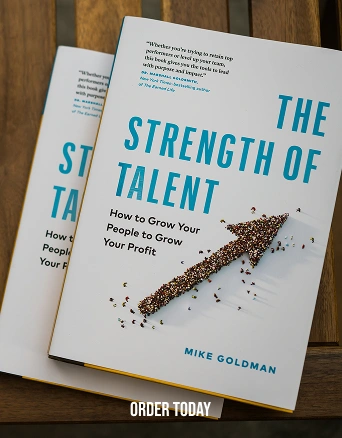
📖 Pre-order my new book The Strength of Talent: How to Grow Your People to Grow Your Profit at http://strengthoftalent.com/
If you’re tuning in after October 14, 2025, you can grab your copy there or on Amazon
Thanks for listening!
Apply for a free coaching call with me
Get a Free Gift ⬇️
🆓 The limitless organization short video course
Connect with me
www.instagram.com/mikegoldmancoach/
www.facebook.com/mikegoldmancoach/
www.www.linkedin.com/in/mgoldman10/
I invite you to assess your team In all these areas by taking an online 30-question assessment for both you and your team at
www.mike-goldman.com/bltassessment
-
Mike: Welcome to the Better Leadership Team Show, and if you listened to the last episode. Right before this one, you know I’m doing something a little different. I’ve got a new book launching on October 14th, 2025, and I’m super proud of called The Strength of Talent, how to Grow Your People To Grow Your Profit, and I’m doing a three episode series, this being the second episode, leading up to the launch of the book.
So if you are listening to this before October 14th, go and pre-order my book @ strengthoftalent.com. If you are listening. From the future, then the book is already live out there. So go buy it on Amazon or go to strengthoftalent.com. But let’s dive in. So in the previous episode I talked about why great strategies fail and why traditional performance management.
Doesn’t work.
In this video, I wanna [00:01:00] talk about the signature framework from the Strength of Talent. My new book that I call the Talent Density System. And it’s a five step system to tackle all of the challenges we talked about in the last episodes and maximize your ability to grow your people and therefore grow your profit.
So let me. Describe the overall system. To you. There are five steps in the talent density system, and what I’m gonna do in this episode is describe the five steps. We’re gonna dig into two of them, and then on the next episode, we’ll dig into the remaining three.
The first step is setting expectations.
It’s aligning around a specific set of expectations with each one of your direct reports. Remember the whole point of this system. Is to help you [00:02:00] better learn how to, grow your top team members and retain your top team members, turn mediocre performers into top performers, and make the decisions on your low performers as to who you can coach up and who you need to coach out.
So the first step. In that is to align around a specific set of expectations with each of your direct reports. That’s step number one. Step number two is to assess performance against those expectations. Step number three is to take massive action against. that assessment. Step number four is to drive accountability.
Accountability for yourself in taking those actions, accountability for the rest of the leaders around the leadership team in taking actions as a result of that assessment. And lastly, it’s to cascade this process down through the organization. So in this episode, I’m gonna [00:03:00] dig into. Setting expectations, that first step, and and assessing performance against those expectations.
So let’s start with expectations. And in the talent density expectation model, there are two components, productivity and culture fit. Now those two make up performance. and I use my words, very carefully because most leaders, you know, kind of use the words performance and productivity to mean the same thing.
And to me, performance is about a lot more than productivity. I actually think culture fit in a lot of ways is a more important component. Of performance, then productivity is. But let’s talk about productivity and culture fit as the two components we’re gonna use to assess performance and therefore the two components you need to use as a leader in setting clear [00:04:00] expectations.
and by the way, super important thing to remember is that unclear expectations lead to unacceptable results. Not unclear results, but unacceptable results. We need to drive clarity.
So let’s start with productivity. For productivity. When I say productivity, it does not mean how long and hard someone is working.
In fact, someone might be working long and hard because they’re not very productive. Productivity boils down to two to four. Measures of success, so you might call them key performance indicators, KPIs, if you own the marketing function, how do you measure success? Is it that the new website went live on time and on budget?
The new logo looks really good. There’s a whole bunch of people [00:05:00] clicking on our email campaign, or we’ve got a thousand new followers on Instagram. Or is it. 10 marketing qualified leads per week consistently. I don’t know what it is for you. I hope it’s something closer to the marketing qualified leads, but we’ve gotta start out what are those measures of success For marketing, it might be marketing qualified leads for sales.
It might be new revenue, it might mean gross, new revenue. It could be gross margin on that revenue. For finance, it might be net cash flow, but what are the metrics? That are measures of success for your function and for the functions of each of your direct reports. There need to be expectations or targets for each of those measures.
It’s not enough to say, gross margin is a measure of success for sales. We need a target. We need to say a gross margin of 52%. [00:06:00] Is our target. It’s not enough to say marketing qualified leads is our measure. It’s 10 marketing qualified leads per week. Higher frequency measures are better. If I stick with marketing qualified leads, having a measure that’s annual, we need to bring in, you know, 500 marketing qualified leads this year.
It is a bad way to measure success. There’s too much time there. There’s no sense of urgency. There’s no ability to react if things change. There’s no real accountability. You are halfway through the year. You only have 25 of the a hundred. You could still say, oh, it’s coming. We’ve got some good stuff coming quarterly.
Same problem, too long a period of time. We need a measure that’s gonna light a fire up your butt to move things forward. Monthly is better than quarterly. Weekly is better than monthly. Daily is probably pushing it, but the higher the frequency measure, [00:07:00] the more, of an ability you have. And more frequently you can hold people accountable and you can also zig and zag as the world changes.
We need for productivity, both leading and lagging. Measures. What do I mean by that? A lagging measure is the measure of a result. Anything on your P&L. Revenue, gross margin, net profit, SG&A, those are all lagging measures. That’s measures of what you did yesterday. A leading measure is the measure of an activity that drives a lagging measure.
The measure of an activity that drives a result. So if your sales lagging measure is new revenue, think about what a leading measure would be. The lagging measure is new revenue, a leading measure, an activity that drives the result of that might be the number of sales meetings we’re having with key decision makers each week.
So we need both [00:08:00] lagging and leading indicators. Leading indicators because they’re, it’s easier to think about how we impact a leading indicator. If you’re lagging indicator of sales revenue and you’re selling enterprise software that takes six months to close, we may not know for a long time whether you’re doing the right thing.
If all we’re doing is a lagging measure. If we look at leading measures, we know right away. Last characteristic of a great productivity expectation is it’s set collaboratively. If you sit down with your direct report and say, here are the four measures of success for you. You own it, not them.
If there’s a problem, when you try to hold them accountable, they’re very easily gonna say, Hey, I didn’t think this was realistic anyway. And maybe it wasn’t, and maybe you’re not the smartest person in the room. Maybe they have some better ideas. So you wanna set these measures collaboratively. With them how collaboratively is gonna depend on [00:09:00] the maturity of your direct report.
There’s some direct reports that are so mature from a business and a planning standpoint that you could say, Hey, by Tuesday I need your most important two to four measures. Make sure they’re leading and lagging. They’ll come back to you with something that’s probably 90% right. The folks that are less mature leaders.
You may need to spend some more time with them. You still wanna work collaboratively, but it may take a little bit more spoon feeding to make that happen. So that’s productivity. We want to set productivity expectations, specific measures of success with our direct reports. And by the way, if you don’t have productivity measures, start off by creating them for yourself.
That’s the first component of setting expectations.
The second component is. Culture fit. Culture fit is typically something that is not very measurable, but you’ll see as we move on in this process that I try to make it [00:10:00] way more fact-based and way more measurable. Yeah. But culture fit ideally is about having somewhere between three to six non-negotiable core values for your company, the characteristics that make your company culture, great and best and most noble.
Those core values are not just beautiful sounding terms, they’re specific behaviors that are clearly identified. If you are in the renewables industry, sustainability is not a core value unless you go check your direct reports garbage every week and see how they’re separating recyclables. It’s a nice thing to say on your website.
But culture fit and core values is not about what looks great on your website. It’s about having a specific set, three to six core values that are specific behaviors clearly [00:11:00] identified and defined. Another way to think about culture fit and these core values is when you are aligning around expectations with your people.
Next one, we talk about performance, assessing performance is, does this person make the people around them better or worse, are they adding to or subtracting from your desired culture? So we wanna set expectations around productivity, around culture fit very clearly and collaboratively. That’s step one in the talent density system.
Setting expectations.
Step two is assessing performance. I want you to picture, and I’m not gonna show a slide here because I know some of you are watching on YouTube, but some of you are listening, so I don’t wanna handicap you if you can’t see a slide. So I’m gonna describe this as best I can without a slide.
But imagine when you’re assessing performance [00:12:00] that. You are starting with those two components or two axes. The x axes is productivity from zero to 10. The Y axes and the X axes goes horizontally. The Y axes going up and down vertically is culture fit. On a scale of zero to 10. When culture fit and pro productivity come together on this set of axes, we wind up in the talent density system assessment model.
We wind up creating four different categories of performance that we use when assessing our direct reports. If someone is performing at a high level in both. Productivity and culture fit. We call those folks high performing. If someone is performing at a low level and we’ll a couple minutes, we’ll get to what I mean by [00:13:00] high and low.
But if someone is performing at a low level in Culture fit, I don’t care how productive they are. Those folks. The category we use for those folks is simply low culture fit. And when I say I don’t care how productive they are, they could have a nine or a 10 outta 10 in productivity. But if they’re low in culture fit, if they are repeatedly and blatantly violating your core values, then they are very possibly toxic to your organization.
Although they themselves might be productive, they’re hurting the productivity of the people around them. So we call them low culture fit. If someone is low in productivity and they’re not already categorized as low culture fit, someone’s low in productivity, we simply call them low producing. And then everyone else, folks that aren’t high enough performing in productivity and culture fit to be considered in the high performing [00:14:00] category, but they’re not low enough to be in one of the two low performing categories, low culture fit or low producing.
They are. Medium performing. Now, a few things about those four categories. First, why do we care? Why do we need to categorize performance in the first place? And I will tell you it’s not so that. Annual or quarterly performance review times, and I hate those processes. It’s not that you can go back to people and tell them how you rated them.
Congratulations. You’re high performing, you’re medium performing. You might wanna find a different industry. When we tell people how we rate them in that way, or their meets or exceeds or their 1, 2, 3, or four, all we get is defensiveness. We wanna coach our people. We don’t have to tell them how we’re rating them.
So if that’s the case, why do we do this? Who cares about those four categories? We care because as a leadership team, [00:15:00] it gives us a common language to assess performance, so it’s more fact-based. It gives us a common language around prescribed actions, which we’ll talk about in the next video next week on this show.
So it gives us a common language to assess performance, a common language to come up with actions because there are prescribed actions for each level of performance. It gives us a common language and an ability to hold each other accountable for making sure that those actions drive people up into the right on that matrix towards high performing.
And it gives us a way. You will find out in the next video, it gives us a way to actually measure what I call the talent density index of your team or your organization. So that’s why we use those categories. Now, it’s also important to talk about the specific labels that I used. Notice I called them high performing, [00:16:00] medium performing, low producing, and low culture fit.
In my last book, breakthrough Leadership Team. And up until probably a couple years ago, I use the terms A, B, C, and toxic C. Now, let’s be honest, those are catchier. Those are more memorable. But here’s the problem. Those are labels people put on people. That sounded very static. I was when I changed my mind on this, I was working with a brand new client and we were talking about folks that I called and they called B players.
The problem was they started thinking about these folks. Is this as if that’s who they really were. As if 35 years ago, the nurse came out and said, I’m sorry, Mr. Goldman, your wife has given birth to an eight pound, two ounce B player. I don’t think that’s the truth. Yes, they were talking about these folks and saying things like, well, you know, B players.
They just wanna leave at five o’clock. they [00:17:00] just wanna, they wanna do enough to not get fired and they’re not gonna do anymore. Again, it was this, if that’s who they were, and it allowed them as leaders to take no accountability for the problem. So I said, wait a minute, is it possible that these folks are performing at this level because of you?
Because you’re not leading them effectively because you’re not coaching and developing them enough because you haven’t inspired them with a powerful vision because you’ve got ’em following a crappy process, or your strategy sucks. Is it possible It’s you? and I want you to think about that. Now, of course, our team members are responsible for growing their own careers, but we have responsibility as well.
We hired them. If you’ve got someone performing at a medium level. It may be because of things that you are doing or not doing. So by calling the medium performing notice, the ING at the end, that’s how they’re performing Now. [00:18:00] It’s not who they are. Now you might say, well, we could still call people A players ’cause that’s a compliment.
And while I agree that might be a compliment. If you are on my team and I believe you are an A player psychologically, that leads me to say I could leave you alone and go follow up, go deal with my problem children. As a high performing team member is that the way you wanna be treated, do you wanna be ignored?
So the labels are important. Now the other thing that becomes important as you assess performance is we wanna make this more fact-based. And I used to say very simply, on a scale of zero to 10 rate productivity for this person, on a scale of zero to 10 rate, culture fit based on your core values.
And while that added value, your six may be somebody else’s eight. So I have a very specific, and I’m [00:19:00] not gonna read them off to you. Now, here’s where I’m gonna say, read my book, my order, my new book, the Strength of Talent. Somewhere in this post is a link to pre-order the book or order the book if it’s after October 14th, 2025.
In my book, I have a very specific set of guidelines for productivity. What does it mean to be a 10 or a nine or an eight or a seven? For culture fit again, what does it mean to be a 10, a nine, an eight, a seven. These guidelines, when you are working with your leadership team, give you again, a common language and a set of facts so that this isn’t just pie in the sky ratings.
So I shared a lot with you over the last 20 minutes or so. I’m gonna save the remaining three. Steps to the next podcast in this little three podcast series, but I [00:20:00] wanna leave you with a couple of questions. How can you set clearer expectations for your team members? Yes, go read my book and find out more, but you don’t have to wait until you read my book.
What could you do today to set clear expectations for each of your direct reports? And how could you create a more regular fact-based assessment of their talent? Again, read my book for more. Go to strengthoftalent.com. In the next video, we’re gonna talk about the last three steps in the talent density system.
Until then, you know, I always say,as the leadership team goes, so goes the rest of the company. If you want a better leadership team. Man, this is the stuff we’ve gotta do. I hope these videos are helping you get closer to that [00:21:00] breakthrough leadership team. Talk to you soon.
​